Diving into Future of DevOps
The Future of DevOps: What’s Next?
DevOps has already transformed the way we build, deploy, and maintain software. But as technology continues to evolve, so too will the DevOps practices we know today. In this post, we’ll explore the trends and innovations shaping the future of DevOps.
DevOps is projected to experience significant growth over the next several years, with an estimated annual growth rate of 25% from 2024 to 2032. A key factor driving this expansion is the integration of AI and ML into the software development lifecycle. These technologies enhance predictive analytics, streamline automated testing, and enable smarter monitoring, ultimately optimizing the entire DevOps process
Let’s focus on a few trends influencing software development in the coming year.
Gen AI adoption in AIOps: AIOps (Artificial Intelligence for IT Operations) refers to the use of artificial intelligence (AI) and machine learning (ML) technologies to automate and enhance various aspects of IT operations, including monitoring, issue detection, root cause analysis, and automated remediation.
AIOps, the growing DevOps trend of applying AI to IT operations, will continue to grow. The AIOps market is currently valued at $1.5 billion and is expected to grow by about 15% each year through 2025.
DevSecOps: DevSecOps is a key trend in DevOps that focuses on integrating security throughout the software development process. It combines development, operations, infrastructure, and cybersecurity within the CI/CD pipeline to identify and address security risks early on. The goal is to automate and monitor security across the entire software lifecycle, leading to faster development, more secure applications, and fewer issues in production.
The future of DevSecOps will see deeper security integration into DevOps pipelines, emphasizing early security testing (shift-left), automation with AI and machine learning, and "Security as Code." Developers will receive more security training, and collaboration between development and security teams will increase. Recent research highlights the growing adoption of DevSecOps, with 37% of organizations extensively incorporating security into their DevOps processes and 33% doing so on a limited basis.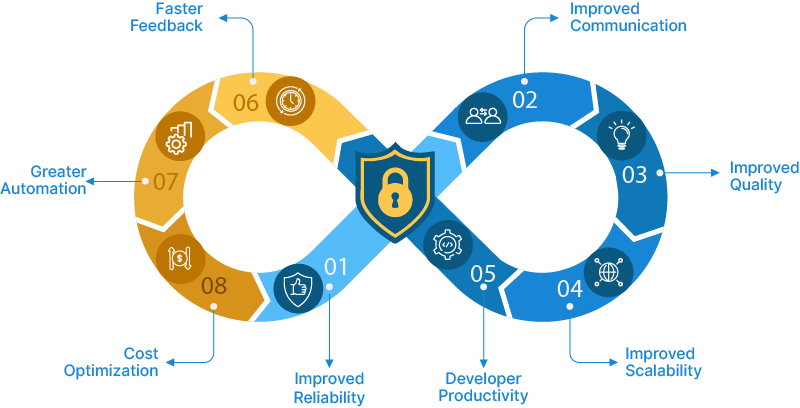
Embracing Serverless Architecture: In the near future, many DevOps teams will start using serverless architecture to deploy their applications. This means they won’t have to worry about managing or maintaining servers. Instead, they can use services like AWS Lambda, Google Cloud Functions, and Azure Functions, which handle all the technical details for them.
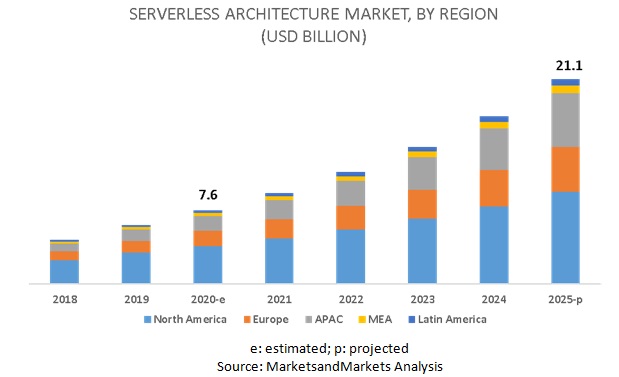
This shift helps save money because they only pay for the computing power they actually use, instead of paying for fixed server resources. Serverless Architecture Market size was valued at USD 7.6 Billion in 2020 and is poised to grow from USD 21.1 Billion in 2025 to USD 62.46 Billion by 2032, growing at a CAGR of 22.8% during the forecast period (2025-2032).
Microservice architecture is a way of designing applications by breaking them into small, independent pieces called "services." Each service handles a specific function or task of the application. Instead of having one large, complex application, you have several smaller, simpler services that work together. This makes the application easier to manage, more flexible, and more scalable.
Microservices Architecture Market Size was valued at USD 6.5 Billion in 2023. The Microservices Architecture industry is projected to grow from USD 7.7 Billion in 2024 to USD 30.0 Billion by 2032, exhibiting a compound annual growth rate (CAGR) of 18.5% during the forecast period (2024 – 2032).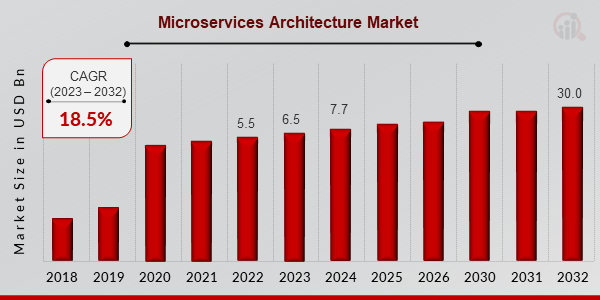
Integrating MLOps into DevOps: MLOps is a useful approach for the creation and quality of machine learning and AI solutions. By adopting an MLOps approach, data scientists and machine learning engineers can collaborate and increase the pace of model development and production, by implementing continuous integration and deployment (CI/CD) practices with proper monitoring, validation, and governance of ML models.

As organizations increasingly adopt AI and ML, the need for a well-defined MLOps framework becomes apparent. The maturity in building ML stacks is still evolving, and businesses must evaluate their readiness, considering factors like business needs, data availability, and technical resources.